Explore how moisture, airflow, and fan time work together. Start with the basics, then try the examples.
01 / MOISTURE BALANCE
Which way will moisture move?
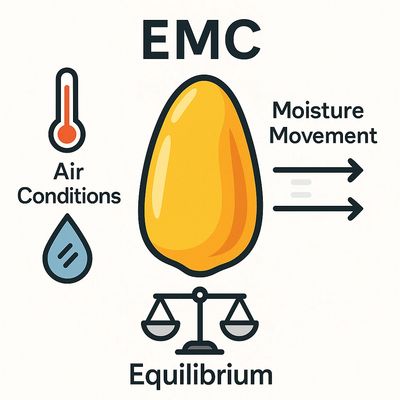
EMC is the grain moisture level that would eventually balance with a particular air temperature and relative humidity. It also depends on the crop. Compare that EMC with your grain’s current moisture.
These sliders explore the relationship. For a crop-specific EMC calculated from temperature and humidity, use Fan Buddy.
GRAIN MOISTURE16.0%
AIR’S EMC12.0%
Grain⟶Moisture moves toward airAir
4.0percentage points EMC below grain moisture
NEAR-BALANCE HOLDING WINDOW15.0–17.0% EMC
Within 1 percentage point of grain moisture in either direction.
Drying potential
The grain tends to lose moisture toward the lower EMC.
Green · within 1 pointYellow · over 1 to 4 pointsRed · over 4 points
These colors show the size of the moisture difference, not a fan-control recommendation. The 2-point holding window is a visual guide: a small difference can still move moisture over time. Larger differences mean a stronger drying or moisture-gain tendency, not a measured rate.
Why EMC matters for grain quality and costs
Understanding EMC helps you avoid unwanted moisture gain and excessive drying. That can help protect grain quality, reduce unnecessary weight loss, and avoid fan hours that work against your goal. Grain temperature, moisture distribution, and regular checks remain important for storage condition and market quality.
What this does—and doesn’t—tell you
Below grain moisture: drying potential. Above grain moisture: moisture-gain potential. At the same value: moisture balance. EMC is a destination, not a drying speed or a measurement of moisture throughout the bin. Airflow, grain depth, temperature, and time affect how the grain responds.
Cooling is a separate goal: also consider air and grain temperatures. A moisture comparison alone is not a fan command.
02 / INSIDE THE BIN
Good air has to reach the grain.
Select a location to follow a typical upward-airflow system. This is a schematic, not a sensor-placement or installation plan.
Outside air & fan
The fan moves air into the bin. Outside temperature and humidity help establish its starting EMC. Heating changes the air conditions, so ambient EMC may differ from plenum EMC.
GrainSight combines grain temperature readings with EMC measurements from the ambient air, plenum, and roof sensor to guide automated fan control. Together, these readings help track how the air and grain are interacting as you work toward your selected storage goal.
A sample day shows why a clock alone cannot describe drying or moisture-gain potential. Switch the goal to highlight the relevant parts of this illustrative EMC curve.
Blue: air EMCGold dashed: targetWhite dashed: starting grain moistureGreen shading: potential in the selected direction
Synthetic example—not a forecast, a runtime estimate, or Fan Buddy’s recommendation algorithm. Shading compares EMC with starting moisture only. Very dry air can overdry grain; high-EMC air can over-wet it. Target, temperature, airflow, storage condition, and progress still matter.
See the hourly values
Hour
Air EMC
Moisture direction
04 / ILLUSTRATIVE CALCULATIONS
See what changes the numbers.
These examples explain the arithmetic. They are not customer results or promises of drying time, safe reconditioning, or financial return.
Fan Runtime & Cost (Corn Drying)
Running 24/7 vs. running when EMC favors corn drying. Compare the same fan over a 20-day period. Start with an illustrative estimate of 45% favorable air, then adjust it to see how runtime and electricity costs change.
The share of hours when the air’s EMC suits your corn-drying goal. The 45% starting value is an example, not a measured seasonal average; weather and moisture targets change this percentage.
Running 24/7
Favorable EMC only
Assumptions & formula
20 days × 24 hours = 480 available hours. Favorable-air runtime = 480 × favorable-air percentage ÷ 100. At 45%, that is 216 fan hours, compared with 480 hours running continuously.
Cost = electrical input kW × fan hours × $/kWh. This simple comparison assumes the fan runs during every favorable hour and stays off otherwise, at constant electrical input. It compares electricity over the same calendar period, not the time needed to reach the same final corn moisture. Cooling and other fan needs are not included.
Use measured electrical power when available. Motor horsepower × 0.746 is rated mechanical power, not actual electrical input; efficiency and loading affect consumption.
Moisture & Weight (Soybean Reconditioning)
What happens to soybean weight when moisture increases? Start with 60,000 bushels at 10% moisture and compare that same soybean dry matter at 12.8%. The added weight comes from water. Change the bushels or either moisture value to explore your own example.
Uses 60 lb per soybean bushel to calculate starting weight. Enter bushels at the starting moisture, before any moisture shrink adjustment.
Starting weight
Weight at comparison moisture
Assumptions & formula
Starting weight = entered bushels × 60 lb/bu. Bushels here are weight equivalents, not a measurement of bin volume or test weight.
Final weight = starting weight × (100 − starting moisture) ÷ (100 − comparison moisture). All moisture values are wet-basis percentages. Dry matter is held constant, with no handling or spoilage losses. Added weight is water, not added grain dry matter.
This is not a prediction of sale proceeds or a reconditioning recommendation. Buyer shrink schedules, discounts, costs, grain condition, and the feasibility of reaching the comparison moisture are not modeled. Rewetting can be uneven and cause damage; EMC timing does not eliminate those risks.
The EMC explanation is supported by the University of Arkansas guide available in our resources. The daily curve and numerical comparisons here are illustrative.